Corporate AutoCAD Architecture Training Course
Edstellar's instructor-led AutoCAD Architecture training course equips teams with basic commands and tools for drawing, dimensioning, and printing techniques. The course enables employees to create views and sheets and prepare documentation for printing, ensuring their designs are ready for implementation in architectural projects.
(Virtual / On-site / Off-site)
Available Languages
English, Español, 普通话, Deutsch, العربية, Português, हिंदी, Français, 日本語 and Italiano
Drive Team Excellence with AutoCAD Architecture Corporate Training
AutoCAD Architecture is a specialized version of AutoCAD software tailored for architectural design, allowing architects to efficiently create and annotate building designs with specific tools and features catered to architectural workflows. In an organization, AutoCAD Architecture is essential for architects and designers to streamline the design process, improve accuracy, and enhance collaboration by providing specialized tools for architectural drafting, detailing, and documentation. Training in AutoCAD Architecture equips employees with the skills and knowledge needed to utilize the software effectively for architectural design projects, enabling them to create precise and detailed building plans efficiently.
Edstellar's instructor-led AutoCAD Architecture training course equips employees with practical skills for architectural design and drafting tasks. Led by industry experts with extensive experience in this domain, the course provides hands-on training and a customizable curriculum tailored to meet specific organizational requirements. Through virtual/onsite training sessions, employees gain proficiency in utilizing AutoCAD Architecture to create detailed architectural drawings, floor plans, and 3D models, enhancing their efficiency and productivity in architectural projects.

Skills Your Employees Will Gain
These are the core, hands-on capabilities your team builds during the program.
- CAD DraftingCad Drafting is the process of creating precise technical drawings using computer-aided design software. This skill is important for architects and engineers to visualize and communicate design concepts effectively.
- Architectural DesignArchitectural Design is the art and science of creating functional, aesthetic structures. This skill is important for architects and urban planners to ensure innovative, sustainable environments.
- Building Information Modeling (BIM)Building Information Modeling (BIM) is a digital representation of physical and functional characteristics of a project. This skill is important for architects, engineers, and construction managers as it enhances collaboration, improves accuracy, and streamlines project delivery.
- 3D Modeling3D Modeling is the process of creating three-dimensional representations of objects using software. this skill is important for roles in animation, game design, and architecture, as it enables visualizing concepts and enhancing creativity.
- Construction DocumentationConstruction Documentation involves creating and managing essential project records, including drawings, contracts, and specifications. This skill is important for architects and project managers to ensure compliance, facilitate communication, and maintain project integrity.
- Layer ManagementLayer Management is the ability to organize and control various layers of information or processes in a project. This skill is important for roles in project management and design, ensuring clarity, efficiency, and effective communication.
What Your Team Will Achieve After This Training
- Apply the architectural drafting techniques to create precise floor plans, elevations, and sections that meet industry standards for detail
- Utilize advanced tools and functionalities of AutoCAD Architecture to streamline workflow processes, optimizing efficiency in architectural design projects
- Analyze and interpret architectural drawings effectively, ensuring adherence to design specifications and regulatory requirements
- Develop proficiency in integrating architectural designs with Building Information Modeling (BIM) workflows, facilitating collaboration and coordination across project teams
- Explore techniques for creating 3D models and renderings, enhancing visualization and communication of architectural concepts to clients and stakeholders
Topics & Program Outline
The curriculum is organized into focused modules built by industry experts and delivered virtually or on-premise. Interactive sessions reflect the evolving demands of the workplace, keeping the learning both relevant and practical.
- About Autodesk & AutoCAD
- History and evolution of Autodesk
- Key features of AutoCAD
- Comparing AutoCAD with other CAD software
- CAD history
- Early developments in CAD technology
- Major milestones in CAD evolution
- The impact of CAD on engineering and architecture
- Graphical user interface
- Navigating the AutoCAD interface
- Customizing the interface for efficiency
- Application menu
- Accessing and using the application menu
- Customizing the application menu
- Frequently used commands in the application menu
- Workspaces
- Overview of AutoCAD workspaces
- Switching between workspaces
- Customizing workspaces
- Ribbon
- Navigating the ribbon
- Customizing the ribbon
- Ribbon tabs and panels
- File tabs
- Managing file tabs
- Customizing file tabs
- Using file tabs for efficient workflow
- Accessing help
- Using the AutoCAD help system
- Online resources and support
- Tips for finding help on specific topics
- Drawing templates
- Benefits of using drawing templates
- Creating custom templates
- Managing and organizing templates
- Standards-based design
- Understanding CAD standards
- Implementing CAD standards in projects
- Create new drawings and templates
- Starting new projects with templates
- Setting up drawing properties
- Saving templates for future use
- Managing layers
- Layer properties and organization
- Layer states and visibility
- Layer management techniques
- Configure object property settings
- Setting object properties
- Property management strategies
- Automatic management of layers
- Auto-layer functionality
- Configuring auto-layer settings
- Benefits of automatic layer management
- Layer functions and display
- Customizing layer functions
- Layer display options
- Layer filtering and searching
- Drawing creation workflows and organization
- Efficient drawing setup
- Organizing drawing elements
- Workflow optimization techniques
- Structuring data in drawings
- Data management strategies
- Using blocks and attributes
- Layer and property management for data structuring
- Reusing and editing structured data
- Techniques for reusing data
- Editing and updating data structures
- Core design tools: Creating rectangles, placing hatch, fillets, chamfers, contours
- Drawing rectangles and squares
- Applying hatch patterns
- Creating fillets and chamfers
- Power snaps
- Understanding snap functionality
- Customizing snap settings
- Advanced snapping techniques
- Centerlines
- Drawing and editing centerlines
- Using centerlines in design
- Centerline tools and tips
- Construction lines
- Working with construction lines
- Applications of construction lines
- Designing with lines
- Basic line drawing techniques
- Advanced line design strategies
- Line type and weight considerations
- Adding standard feature data for holes and slots
- Tools for creating holes and slots
- Standardizing hole and slot dimensions
- Managing feature data
- Editing tools
- Key editing commands and tools
- Advanced editing techniques
- Tips for efficient geometry editing
- Power commands
- Exploring powerful AutoCAD commands
- Custom commands and macros
- Command shortcuts for faster design
- Associative hide
- Using the associative hide feature
- Managing hidden geometry
- Model space views in layouts
- Setting up model space views
- Managing views in layouts
- Tips for effective view management
- Creating drawing sheets in model space
- Steps for creating drawing sheets
- Customizing sheet settings
- Efficient sheet management strategies
- Annotation
- Annotating drawings for clarity
- Managing annotation scales
- Customizing annotation styles
- Title blocks and drawing borders
- Designing title blocks
- Automating drawing borders
- Annotation and annotation symbols
- Understanding annotation in AutoCAD
- Customizing annotation symbols
- Creating dimensions
- Dimensioning tools and techniques
- Managing dimension styles
- Advanced dimensioning strategies
- Editing dimensions
- Techniques for editing dimensions
- Dimension property management
- Printing concepts
- Understanding print settings and preferences
- Choosing the right printer or plotter
- Managing color and print quality settings
- Working in layouts
- Navigating the Layout tab
- Customizing layout viewports
- Efficient layout management strategies
- Creating layouts
- Starting a new layout from scratch
- Using layout templates for consistency
- Integrating views and viewports into layouts
- Guidelines for layouts
- Maintaining clarity and readability in layouts
- Tips for effective layout design
- Import & export
- Techniques for importing external files into AutoCAD
- Exporting drawings to different file formats
- Managing file compatibility and conversion issues
- DWG files
- Understanding DWG file structure and management
- Strategies for efficient DWG file organization
- Recovering and repairing DWG files
- IGES files
- Working with IGES files in AutoCAD
- Importing and exporting IGES file formats
- Project documentation
- Organizing project files and documentation
- Automating documentation workflows
- Maintaining version control and revisions
- Printing layouts
- Setting up print configurations for layouts
- Customizing print settings for specific needs
- Print & plot settings
- Understanding the plot dialog box settings
- Configuring plot styles and pen settings
- Managing paper sizes and scale settings
- Projects printing/plotting
- Strategies for batch printing and plotting
- Managing large project print jobs
- Quality control and checking for print and plot outputs
Who Should Attend?
This program suits professionals at many levels across the organization, including:
- Architects
- Architectural Technicians
- Interior Designers
- Mechanical Engineers
- Building Information Modelers
- Structural Engineers
- Civil Engineers
- Urban Planners
- Construction Engineers
- Project Coordinators
- Landscape Architects
- Managers
What are the Prerequisites?
Employees with a basic understanding of subjects like engineering graphics & civil / architecture drawing can take the AutoCAD Architecture training course.
Choose the Format That Fits Your Team
We design training your teams actually engage with, and deliver it the way that suits you best. Through a vetted global trainer network, Edstellar runs sessions in 10+ languages with consistent quality anywhere.


.webp)
Virtual / online: expert-led live sessions delivered anywhere, with consistency and easy scheduling.
.webp)
On-site (in-house): immersive, instructor-led learning at your office.
.webp)
Off-site: focused, instructor-led group learning away from everyday workplace distractions.
Get a Proposal Shaped to Your Needs
Need pricing for onsite, offsite, or virtual delivery? Get a proposal tailored to your team's needs.
64 hours of group training (includes VILT/In-person On-site)
Tailored for SMBs
Tailor-Made Trainee Licenses with Our Exclusive Training Packages!
160 hours of group training (includes VILT/In-person On-site)
Ideal for growing SMBs
Tailor-Made Trainee Licenses with Our Exclusive Training Packages!
400 hours of group training (includes VILT/In-person On-site)
Designed for large corporations
Tailor-Made Trainee Licenses with Our Exclusive Training Packages!
Unlimited duration
Designed for large corporations
What Sets Edstellar Apart
Experienced Trainers
Our trainers are drawn from a vetted global network and bring years of industry expertise, keeping every session practical and impactful.
Proven Quality
With a strong global track record, Edstellar is known for quality and engaging delivery.
Industry-Relevant Curriculum
Our programs are built by experts to match the demands of today's industry.
Fully Customizable
Every program can be tailored to your organization's goals.
Comprehensive Support
We provide pre- and post-session support for a complete learning experience.
Global Multi-Location & Multilingual Training Delivery
We deliver in multiple languages to support diverse global teams.
Hear from Organizations We've Trained
"This AutoCAD Architecture course was exactly what I needed to advance my career. As a Senior Software Engineer, mastering advanced methodologies has become crucial for my success. The in-depth coverage of practical frameworks I use daily. My ability to architect solutions and solve complex problems has improved substantially. The real-world examples and deep dive into expert-led workshops were particularly valuable for my professional growth.”
Mason Crawford
Senior Software Engineer,
Digital Innovation Platform
"This AutoCAD Architecture course equipped me with comprehensive industry best practices expertise that I've seamlessly integrated into our enterprise practice. The hands-on modules covering interactive labs and hands-on confidently design solutions that consistently deliver measurable business results. Our project success rate and profitability increased dramatically within the quarter, validating the immediate impact of this training program.”
Tim Van Der Meer
Senior Software Engineer,
Enterprise Software Development Firm
"As a Senior Software Engineer leading professional expertise operations, the AutoCAD Architecture training provided our team with essential strategic frameworks expertise at scale. The comprehensive modules on practical across our complete operational footprint. Our stakeholder satisfaction and NPS scores reached unprecedented all-time highs. This course has proven invaluable for driving our organizational transformation and sustained excellence.”
Lata Sengupta
Senior Software Engineer,
Global Technology Solutions Provider
“Edstellar’s IT & Technical training programs have been instrumental in strengthening our engineering teams and building future-ready capabilities. The hands-on approach, practical cloud scenarios, and expert guidance helped our teams improve technical depth, problem-solving skills, and execution across multiple projects. We’re excited to extend more of these impactful programs to other business units.”
Aditi Rao
L&D Head,
A Global Technology Company
Recognition That Motivates Your Team
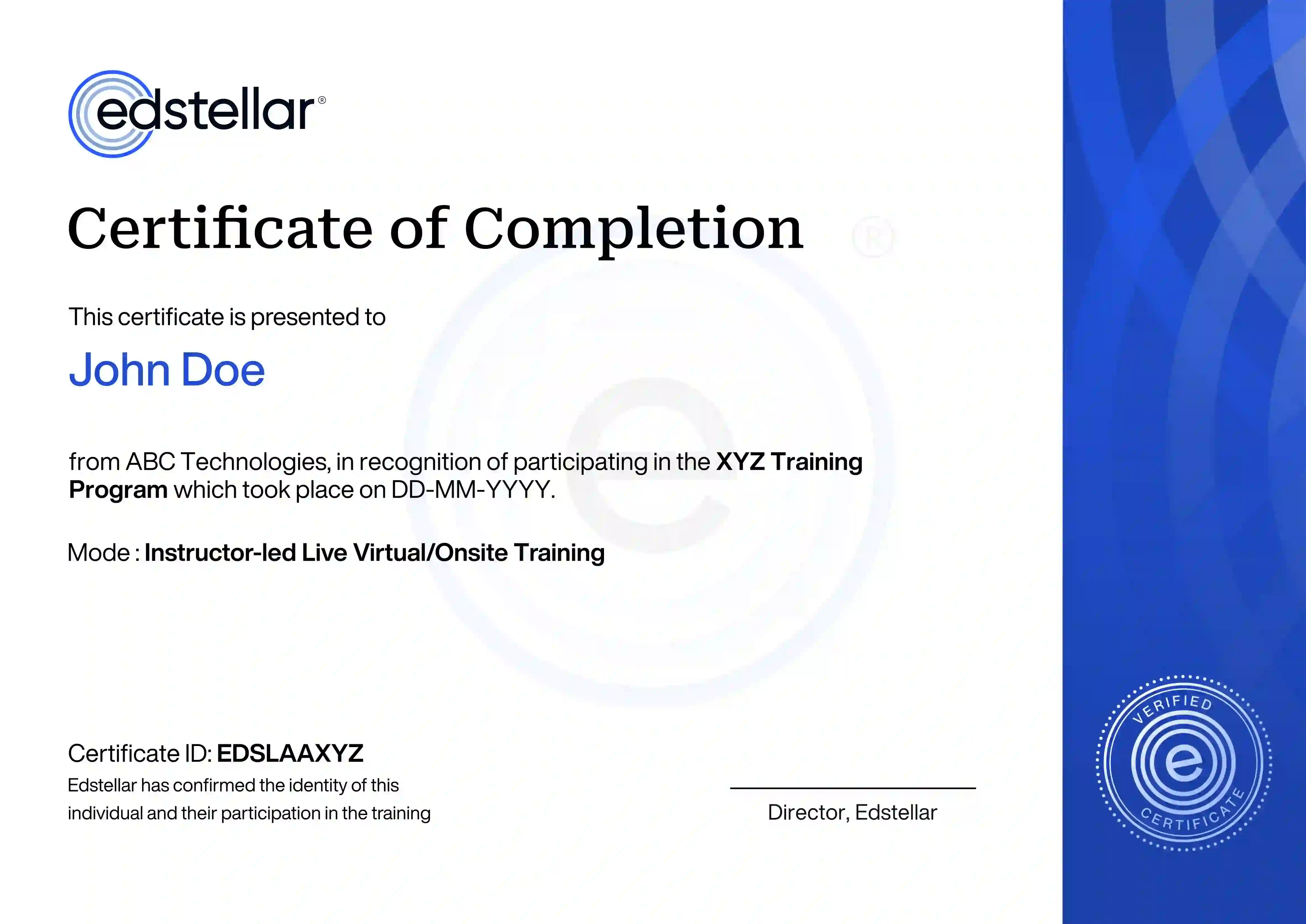
Upon successful completion of the training course offered by Edstellar, employees receive a course completion certificate, symbolizing their dedication to ongoing learning and professional development.
This certificate validates the employee's acquired skills and is a powerful motivator, inspiring them to enhance their expertise further and contribute effectively to organizational success.


Other Related Corporate Training Courses
Explore More Courses
Edstellar is a one-stop instructor-led corporate training and coaching solution that addresses organizational upskilling and talent transformation needs globally.
Learning Technology
Learning Content Design and Development
Learning Governance, Analytics & ROI
Digital Learning Ecosystem
Training Simulations, AR/VR & Case Studies
Employee Performance Support
Leadership Pipeline & Succession PlanningStrategic Workforce Planning for EnterprisesTransformation & Risk Advisory for EnterprisesDEI Consulting for EnterprisesEmployee Engagement Consulting for Enterprises
Cultural Transformation